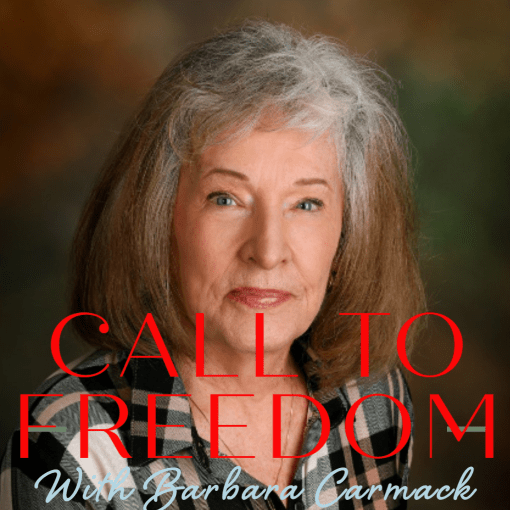

In this episode of Call to Freedom, Barbara Carmack delves into the profound significance of blood in God’s plan of redemption, tracing its importance from the covenant with Abraham to the celebration of Passover. She explores the symbolic sacrifices in Leviticus 17 and its implications on atonement and reconciliation between God and humanity. Darren joins Barbara in a captivating discussion that brings to light the profound obedience required in following God’s divine plan. Listeners will gain insights into how these sacred traditions and scriptures lay the foundation for understanding sin, redemption, and a life of faith. Barbara passionately discusses
SPEAKER 01 :
Welcome to Call to Freedom with Barbara Carmack. This is Jimmy Lakey, and I’m delighted that you are joining us for this half hour. You can reach Call to Freedom at Box 370367, Denver, Colorado, 80237, or by going to the website at www.freedomstreet.org. If you want to leave a message or order a Word Power Daily Reading Bible Guide or a Freedom Street Express newsletter, you can call us toll free at 1-877-917-7256 and leave your name and address, including your zip code. If you want to talk to Barbara right now, she is expecting your call. You may call that same toll-free number, 1-877-917-7256 to speak to her. And now, let’s join Barbara in the studio.
SPEAKER 04 :
On this Encore show, Darren and I talk about the blood in God’s plan of redemption. Leviticus 17.11 tells us, For the life of the flesh is in the blood, and the life of all flesh, its blood, is identified with its life. When God made a covenant with Abraham, circumcision was the outside sign of the inward work of the heart, and obedience was paramount in ratifying this agreement. Passover will soon be celebrated on March 25th, and this is another confirmation of how important blood is in the redemption story. Now let’s join this important program.
SPEAKER 03 :
Barbara, I want you to talk to us about the scripture in Leviticus that talks about the life or the powers in the blood.
SPEAKER 04 :
That’s right. In the law of God that he brought to his people. Right in the middle of it in Leviticus, Darren. And the book of Leviticus is the book of Levi. That’s the tribe that was set apart as the priestly tribe. And here in Leviticus 17… He’s talking about sacrifices, the blood for atonement. And as we talked before, Darren, we talked about atonement, being at one to make amends, reparations, and that’s where the word repair comes from. We repair something that’s been breached. And this sin that man committed, there was a breach in the fellowship between God and man. So reparations had to be made. And reparations were made through blood. Blood was the thing that God… that satisfied God and satisfied the debt or the offense or the crime that was committed. And it’s used all through the Old Testament. The blood of goats, the blood of animals was given as a sacrifice or an offering to bring about a reconciliation between God and the people that had sinned. So this atonement is really important. Now, the people… In Egypt, when they had been in Egypt, they were worshipping goat demons as well. And God says in verse 7 of Leviticus 17 and says, They shall no longer sacrifice their sacrifices to the goat demons with which they play the harlot. This shall be a permanent statute to them throughout their generations. God is saying, I don’t want you to sacrifice to anybody else but me. And they had been sacrificing to goat demons. And it’s interesting, Darren, to see that the sign of the satanic worshippers is a goat. A goat head is the sign. And that’s what they had been worshipping in Egypt.
SPEAKER 03 :
Now, he was really calling that harlotry.
SPEAKER 04 :
He was. It was whoredom. It was prostitution.
SPEAKER 03 :
They were prostituting themselves. Because really here, he’s talking about a very intimate relationship with his children.
SPEAKER 04 :
He wants it. Yes.
SPEAKER 03 :
You know, I believe what he what he wants to do is look down and not see our sin, but see that blood covering here in the Old Testament context. He was saying, what do I see when I look at you? You know, he’s saying, OK, now here’s a sacrifice. This will make it possible for us to get along here. And for me to forget your sin, you know, push it aside because of the atonement, because of the blood covering.
SPEAKER 04 :
Yes. And some of you are saying now, why did he want blood? Why did God require blood? Well, here we find out in Leviticus 17, verse 11. For the life of all flesh is in the blood, and I have given it to you on the altar to make atonement for your souls. Now there’s that word atonement again, and that means that it’s a reconciliation after enmity or a sin has been committed. This life, this blood, which is life. Now see, when we commit sin, that’s death. We go over into the death stream. We serve the kingdom of darkness, which is death. But God hasn’t given us a life of death in Jesus Christ. He’s given us a life that’s abundant. It’s life. It’s Zoe. It’s God’s own very essence there. So here he says, if you want to live abundant life, if you want to live zoe life, a blessed life, then you believe the blood is important in here. And the blood is important. And Darren, it goes on to say, it is the blood by the reason of the life that makes atonement. Therefore, I said to the sons of Israel, no person among you may eat blood, nor may any alien who sojourns among you eat blood. Now we find out the night before Passover, when they went into their exodus into the promised land, they The meat was roasted so that the blood was roasted out of the meat. And God required that of his children. They do not drink blood or eat that raw meat because that’s the meat that blood was in. For as and in verse 14 of Leviticus 17, for as for the life of all flesh, its blood is identified with its life. So here we see that blood is very, very important here. It’s the very life of human mankind. You’ve said before, you know, when somebody dies and their blood flows all out of their body, they’re dead.
SPEAKER 03 :
Well, let’s say when there’s an injury. Let’s recap that for just a minute. And I had a friend tell me who was in ministry in Omaha, Nebraska. He said, Darren, do you know why people die? People die when they bleed to death. I said, no, I really don’t. He said, I mean, technically, why do they die? And of course, I didn’t know. So I said, well, you have to tell me. He said, well, when that blood ceases to flow around, you know, the blood pressure drops so much because you cut an artery or whatever. and that blood circulation stops flowing around to the vital organs, like the brain and the heart and the lungs and so on. He said it ceases to carry the life force around through the body, and then we have what we call death. And I thought, that is a great explanation, really, of what we’re talking about here. The life is in the blood. When that life force that’s a mystery to us, but it’s carried in the bloodstream. When that ceases to go around in the body because the blood pressure has fallen so low that it no longer can flow where it’s supposed to flow, then that life-giving force is there to the heart, the brain, the lungs, and the vital organs, as we would say, is no longer there to keep them going. That’s almost the electrical current that goes around. That’s a mysterious force, a life force that’s carried in the bloodstream. I think that’s a tremendous explanation.
SPEAKER 04 :
Yes, and God, in his wonderful mercy and love, and I hope you feel his love and mercy today as we’re teaching this. I hope you feel God close to you because he loves you. And it was God’s idea here to cover people’s sin with blood, which is a life force. It energizes. And we’re going to find out in the New Testament that Jesus’ blood energizes us.
SPEAKER 03 :
Now, the power of the blood, when we plead the blood, it’s greater than the power of Satan. We’ve got to know that. We’ve got to really get that firmly rooted in our hearts. And sometimes you’re so beat up and so without resources, the only thing you have is the blood of Jesus to fight with. And it is a battle, folks. I’m sorry to tell you that. But we’re on a battlefield, whether we like it, whether we want to recognize it or not. And the enemy of our souls is after us. He comes to kill, steal, and destroy. And we’ve got to take what we have in our hands. you know, available to us to fight and win that battle, and we’ve got to use the blood to do that.
SPEAKER 04 :
Yes. Now, here we had seen that God made a covenant with Abram, and this is before his name was changed, and this is in chapter 15 of Genesis. The important verse I want you to remember from that chapter is verse 6. Abraham believed in the Lord, and he reckoned it to him as righteousness. Now, we see in Romans 4, 17, that God had… reckoned righteousness to Abraham because he believed God. He didn’t say, oh, I hope so. Oh, maybe someday pie in the sky when I die. No, Abraham believed that when God said, I’m going to give you this land, he gave him that land.
SPEAKER 03 :
But also that word reckoned, sometimes that’s a little difficult for us to understand. He believed in the Lord and it was credited to him or accounted to him or he was considered righteous from then on because of this and because of his wonderful faith. He’s a father of faith. He really introduced faith to the human race here.
SPEAKER 04 :
Okay, and we can see in the new covenant as it’s going to be coming up that when we believe in Jesus Christ and his shed blood on the cross and we believe that he rose from the dead, then God seals that with righteousness for his people. We are reckoned as righteous people when we believe in the blood of Jesus Christ.
SPEAKER 03 :
You know, before we come to Jesus, we’re dead. We’re dead. We’re spiritually dead. When we accept him, we really accept the fact that he’s the son of God, that his shed blood was shed for us on the cross, that he died and went to hell. But because of the power, that power, excuse me, the power of eternal life, he could rise up from the dead. Now, that power of eternal life is what makes us different from the sinners. They have a covenant with death. We have a covenant with life. And eternal life force has more to do than just giving you fire insurance when you die so you don’t go to hell.
SPEAKER 04 :
Yes.
SPEAKER 03 :
It gives us a life force that we need to have to operate as Christians.
SPEAKER 04 :
Okay, now between the covenant God had given to Abram and between the time that he was circumcised at the age of 99, something dreadful happened, Darren, and he took life in his own hands and he had Ishmael. That was not in God’s plan, but he didn’t wait for God. And so many of us, and I include myself, we just don’t wait for God. We’ve got to have it now. We’ve got to have it today. We’ve got to have it at least this weekend. But we can’t wait for the promise of God. But here then in chapter 17, when Abram’s 99 years old, and that’s after he’s had Ishmael, and when he’s 86 years old, Father God comes to him and he says, I am God Almighty. Walk before me and be blameless now, Abraham. Don’t do things on your own anymore. Let me be your guide. Trust in me. Commit yourself to me. And I will establish my covenant between me and you, and I will multiply you exceedingly. And Abram fell on his face, and God was speaking to him. Now, the thing that really sealed this, he renamed him from Abram, Father of Altitude, to Father of Many Nations, Abraham. And we see Holy Spirit in this name. And we see it in Sarah, too, because he brought A-H, which is H. It’s a breath. It’s like when we talk about breathing life, Darren, and we talk about the breath. That’s Holy Spirit. And so he breathed Holy Spirit into Abram, and he became Abraham. And we even hear the Jewish people, they really enunciate that and bring breath into those words. Well, here in the 11th verse, in order to consummate this covenant, he says, “…you will be circumcised in the flesh of your foreskin, and that will be a sign that you are my chosen.” And from that day on, all of those people were circumcised or the foreskin was cut. Now, why was that done?
SPEAKER 03 :
And God insisted on that.
SPEAKER 04 :
That’s right.
SPEAKER 03 :
He insisted on the circumcision for every male, whether even if they were slaves, they were circumcised.
SPEAKER 02 :
Yes.
SPEAKER 03 :
And that was a very important thing because that separated them from the ordinary or we could say, in a sense, sinners or those outside of the covenant. And this was a sign of the covenant.
SPEAKER 02 :
Yes, it was.
SPEAKER 03 :
Circumcision. And I find it very interesting that the seed or the semen flows through the circumcision.
SPEAKER 04 :
Isn’t that something, the seed of circumcision? A man, and also future, future progeny, future children, passes through that circumcised, that sacrificed area on man, the very organ where all of life flows. That had to be cut. Blood had to be an issue here again.
SPEAKER 03 :
And there is, when we really think about it, the bloodline comes through the man, through the sperm. And, of course, the bloodline of Jesus we’ll talk about later came from the sperm of Father God. And so when we get over into talking about taking communion, it’s very, very important. And the basis that we’re giving here is so important to understand the blood of Jesus.
SPEAKER 04 :
Yes, it really is.
SPEAKER 03 :
And it’s a matter. Then, of course, we’re going to elevate this teaching in the New Testament to say, well, now we had circumcision in the Old Testament. There’s still circumcision in the New Testament. But now there’s another kind of circumcision, that circumcision of the heart.
SPEAKER 04 :
Yes, that’s right. It does eliminate the fleshly circumcision, but as Paul writes in Galatians, that isn’t an important issue anymore, not like in the Old Covenant. And we know that circumcision also has physical benefits, and that’s when a person is circumcised, it’s been noted that we’re not prone to disease as much on the man’s body.
SPEAKER 03 :
If we do it according to Scripture.
SPEAKER 04 :
That’s right. So we know that God had now completed that covenant between Abraham. Now, a lot happens now for the people are disobedient. They go into Egypt and. through Jacob and Joseph and Jacob and they go into Egypt and now they’re slaves. And now God calls up a man, Moses, to come and free his people after 430 years of slavery. And Moses comes and there are many signs given, plagues, are put on the nation of Egypt because they will not let God’s people go. And Darren, then after all the plagues, the last of the plagues, and you like to say here that God put these plagues on Egypt because these were all gods, and God was going to show Egypt that he was greater than they were, than all the gods.
SPEAKER 03 :
I believe it’s true that in every one of the plagues, the plague was mocking a specific heathen god.
SPEAKER 04 :
Yes, that’s right.
SPEAKER 03 :
And, for example, God says, you like frogs? We’ll give you a bunch of frogs.
SPEAKER 02 :
Yes.
SPEAKER 03 :
You want to, you know, worship the Nile? Well, we’ll just turn the Nile into blood and see how you like it.
SPEAKER 02 :
Yes.
SPEAKER 03 :
And God mocked every one of those Egyptian heathen gods in one of the curses. And I think it’s so interesting, Barbara, that here God’s children were in slavery. They’d been there for 430 years in slavery. God had to drive his people out of this comfortable zone, this comfort zone, even though it was slavery.
SPEAKER 04 :
Slaves, yes.
SPEAKER 03 :
And, you know, sometimes for us today, God has to grab us by the neck and shake us like a dog would shake a rabbit. So true. And say, listen, you are in the wrong place. I can’t bless you here. I’m going to bless you over there. But you’re not over there yet. And I’m going to have to squeeze you so hard that you get the message. I may have to take your job or your career away from you. And you say, oh, we’ve got to do that to me. Well, he has had to do that in some cases.
SPEAKER 04 :
And some people never get it, Darren. That’s what’s so sad. Some people never get that God’s talking to them and wanting to leave their family and wanting to leave their country.
SPEAKER 03 :
I’ll tell you, if you’re in Denver, Colorado, and you’re supposed to be in Dallas, you better get yourself a U-Haul and get down to Dallas. And you know, God can make that very plain to you. And if he has a plan and the glory spout or the blessings are only going to come at a certain location… And blessings do come in certain locations. Like, why couldn’t God have blessed Abraham over there in the Ur of the Chaldees? Well, it was right over there in the middle of idol worship. He said, I’m going to take you out of here.
SPEAKER 02 :
Yes.
SPEAKER 03 :
Well, he partially obeyed. He was supposed to leave his family, which was really a demonic influence behind. But he took his father along, which he shouldn’t have done, according to Scripture. Well, finally, the blessings really came after his father died.
SPEAKER 04 :
Yes, and they left Haran then and went over to Canaan.
SPEAKER 03 :
Now, God is obviously not anti-family, nor are we anti-family, but I’m telling you, some of you folks are in the wrong location. You’re trying to get blessed there, and God says, this is not where it’s at for you, boy. You’re going to have to go down the road.
SPEAKER 04 :
Well, and we’ve heard, Darren, that in other societies in this world, the Western society has a different mindset about futures of their young people. In the Middle East and some of these countries, like what we’re talking about where Abraham was, the future of the sons is already set. It’s set in concrete. You’re going to do what your father did. And God knew if Abraham stayed there in the Ur of the Chaldees, he would be an idol worshiper just like his father or an idol maker. So he had to get out of that environment. In the West, we have more of an entrepreneurish mindset that fathers don’t give their sons as much advice. Now, it is done. Sons take over fathers’ businesses, but not to the…
SPEAKER 03 :
The mentoring isn’t there as strongly. That’s right, as strongly. And I would say this, you know, one of the first things that Abraham did was to build an altar and start sacrificing.
SPEAKER 04 :
Yes, Abraham built many, many altars, and God loves that offering that we bring to him. He really does.
SPEAKER 03 :
Now, I think when we frustrate that part of us that wants to worship God, when we carry that out through sports, when we carry it out through things, we redirect our worship or our attitudes or our allegiance to certain things. We’re really asking for trouble. And because there is a void down inside of us that’s only satisfied by worshiping, And I believe we need to worship the most high God there. We need to praise him and operate in joy, you know, because of his provision for us. And I think that’s part of this teaching also.
SPEAKER 04 :
Yes.
SPEAKER 03 :
God is laying a marvelous foundation for us.
SPEAKER 04 :
He sure is. And a marvelous. sign over the doorposts, marvelous doorposts, and here we’re going to find in Exodus 12, the last of the plagues that God put on the Egyptians before the people of Israel were delivered was the death of all the male, firstborn male children and animals. So God had this last, Pharaoh was holding out, he was not allowing the people to go, so God had this one last thing, and he knew it would break the back of Pharaoh.
SPEAKER 03 :
Now, I have to say this, that God repeatedly hardened the heart of Pharaoh. He did. Now, some of you are in situations where you say, how come that boss is so hard on me? Or how come, you know, this is just not working out here? You know, I think it would pay us great dividends if we sit down and say, God, are you hardening the heart of this employer that I’m working for? Because as much as I try to please him, I can’t please him or her. Now, God, are you trying to get me out of here? And sometimes we say, oh, the devil’s in that person, you know, this, that, and the other thing. Well, God hardened the heart of Pharaoh to get his people out of there so he could take them to the land of blessing.
SPEAKER 04 :
Yes. Now, this chapter here, Darren, is pivotal. I would put it along with Isaiah 53 about Jesus dying on the cross. It is so messianic in some areas, the Passover lamb. And we see Jesus in Revelation as the lamb of God who takes away the sins of the world. And even John the Baptist talked about it when we see him in the first part of Luke. uh… profit crying out uh… behold the lamb of god who takes this way this in the world even before jesus was crucified it is so prophetic and here in exodus twelve and the very beginning of exodus twelve we see uh… that the month Shall be the beginning of months for the Jewish people. So here the Exodus is the very beginning of their calendar year. Now, our year is run on lunar, but their calendar year begins with a very deliverance of the Jewish people. And it’s the month of Abib. And here we see that God is speaking on the 10th of this month. Each one shall take a lamb for themselves according to their father’s household, a lamb for each household. Here we see a lamb used as a sacrifice. Your lamb shall be unblemished. Now, if there was someone poor, then you would take this man into your home and divide the lamb with him. If he didn’t have a lamb, you shall keep this festival or this feast until the 14th month. And the Jewish people still do keep this Passover. Moreover, they shall take some of the blood in verse 7 and put it on the two doorposts and on the lintel of the houses in which they eat it. They shall eat the flesh that same night roasted with fire. Remember, they couldn’t drink the blood. They couldn’t eat something that was raw. Or as we say when we go into restaurants, how you want your meat cooked. Well, some people want their meat cooked. What do they call it when it’s blood red? Raw. How do they call it? The rare. Do you want your meat rare? And when you ask for it rare, you’re going to see the blood. Well, God told his people he didn’t want blood, so they roasted the sacrifice. Now here he’s saying, I will go through the land of Egypt on that night and will strike down all the firstborn. In the land of Egypt, both man and beast, and against all the gods of Egypt, I will execute judgments. I am the Lord, and the blood shall be a sign for you on the houses where you live. And when I see the blood, I love this, when I see the blood, I will pass over you, and no plague will befall you to destroy you when I strike the land of Egypt. Now, what a wonderful promise. No plague is going to come to destroy you. In fact, Darren, was it the last three plagues did not affect the people? of Israel in that land of Egypt. And I know that one was the hail. They did not receive hail. They did not have darkness in their part of the land. And so God was protecting his people even in enemy territory.
SPEAKER 03 :
You know, I think that story about the darkness, you know, when the sun basically didn’t shine any place except Goshen.
SPEAKER 02 :
Yes.
SPEAKER 03 :
If you think about it, you know, in the Denver area, we have certain areas. We’ve got Littleton. We have Aurora. You know, we can go around Edgewater. We’ve got all these little areas which were at one time little individual communities. Well, what if you stood in Denver and you looked over toward Aurora and Aurora had light and you were standing in solid darkness? I mean, wouldn’t you wonder what in the world is going on? And yet God singled out his people for blessing for extraordinary things to say the blessings over here was not over there. And then I think about God was mocking the bloodline of the Egyptians in killing the firstborn of the children of not only the Egyptians, the royal family and the slaves, but And even the animals, it was like, I’m coming against your bloodline, and I’m saving my bloodline. I’m taking them out of here.
SPEAKER 04 :
Yes. It’s like when we were in Haiti, at the capital of Haiti, at night we went up on a hill, and they showed us the poverty-stricken part of Haiti, which covered probably 50,000 people, and this huge black hole in the middle of this capital. No electricity, no running water. It was black. And the rest of the city then had electricity where the wealthier lived. And it’s such a dynamic difference there. And I can imagine this is what Egypt looked like that night. Well, God said, I want you to feast. And he presented the Passover to them. We can’t go through the Passover today because of limited time limitations. But here when he says, I want you to take a bunch of hyssop. Now that’s verse 22 of chapter 12 of Exodus. and dip it in the blood which is in the basin now this is the blood from the sacrificed lamb they would eat the lamb the roasted lamb but the blood that was poured out of the lamb before it was roasted they would take that dip hyssop in it and apply some of the blood that is in the basin to the lentil and the two doorposts, and none of you shall go outside the door of his house until morning. Then the death angel came at midnight, and the Lord struck all the firstborn of the land of Egypt, from the firstborn of Pharaoh who sat on his throne, to the firstborn of the captive who was in the dungeon, and all the firstborn of the cattle. Now, what’s magnificent about this Passover, Darren, is that the Passover represents the cross of Jesus Christ and the lentil, the doorway even represents the cross, the wood of the doorway that they put that blood on and the blood of Jesus Christ protects us. The blood on the lentil, the doorway protected the people that night from death.
SPEAKER 03 :
You see, I get really excited about modern application of this Passover concept. I believe that if we take communion, and of course we teach that you should take it at home as well as at church, and there’s no place in Scripture where it says you have to be ordained, you have to be a pastor, a priest, a bishop, or whatever. In other words, in the book of Acts, it went from house to house, breaking bread. You can prepare the elements at your house, your bread and your cup. Now, here’s something I would suggest you do. If you’re having problems at your house, and even if you’re not, but let’s say that you’re having problems at your house, I would take a cup and I would take my communion elements and I’d go around, but I’d take a little part of the blood on my finger and I’d put it on the doorposts of my house, inside and outside. So you go to the front door of the house, you do the inside up at the top. which would be like the doorpost, what’s holding up, you know, the top of the door. And I’d go outside and do it on the outside. I would anoint that house with the power of the blood of Jesus. And I would say it out loud with my mouth and make a real ceremony out of it. And I’ll tell you, one night we had some demonic harassment. I got up in the middle of the night. I anointed every window opening. I anointed every door, inside and out. I went out and anointed all four corners of our property plus the mailbox. And I let the devil know, you are an intruder. Now get off of my property.
SPEAKER 04 :
Now, it’s important here, Darren, I wasn’t going to mention this until the New Testament, but it’s important here that we see that during this Passover time, it involves seven days that the Jewish people celebrate this feast. There is no leaven eaten during this time. Now, leaven is representative of sin. in a person’s life i i must also warn people that do take communion you must ask god and check yourself and check your family before you have communion lord is there any sin in my life is there anything that’s keeping me from having that close communion and fellowship with you Thank you for listening to this important program on the blood sacrifices of the old covenant. Next week, Darren and I will continue with the series, the blood covenant and go into the new covenant and the blood of Jesus. Join us next Friday. And until then, may the Lord bless you and keep you.
SPEAKER 01 :
or you may leave your message at… Call to Freedom is a listener supported radio ministry. Barbara and her power partners invite you to come on board with us and become a network of hands holding up Call to Freedom ministry. Power partners support Call to Freedom with prayer and monthly financial support. you will be blessed supernaturally. We invite you to visit Call to Freedom’s website www.freedomstreet.org where you can hear Barbara’s daily radio broadcast 24 hours a day or order materials. You may share your praise reports and heart cries by mailing them to Call to Freedom, Box 370-367, Denver, Colorado, 80237. Or you may email us at barbracarmack at freedomstreet.org. Until next time, remember, Jesus loves you, Barbara loves you, and take joy.
SPEAKER 1 :
you